
Excursions with Clive
The Late Clive Davis: A Personal History

Clive Davis, the most influential record executive of the last 60 years, died at his home in Manhattan, his family announced today. He was 94. I had gotten to know him pretty well over the years, as a rookie out of college in 1972, when I worked for him at CBS Records, to years as a journalist. Here are some reflections.
The last time I saw Clive Davis was in 1993, a 6:30 pm appointment in his office at Arista Records. I was tired of the music beat at Newsday I had held for 18 years, still paying much of my good but unexceptional salary to my ex in child support. My friends in the music business were hauling in six figure salaries, some so high that they became seven figure salaries. I had written to Clive about a job at Arista.
He responded with an open mind: We’d known each other for 20 years, since I worked for him (one step away from a direct report) when he was President of CBS Records, and in my first job after college in 1972 the company’s in-house magazine start-up, Playback. At Playback, I sat in on his weekly top level staff meetings: Albums, Singles, Marketing, Sales, Promotion. He had top executives in every field, and he knew their jobs as well as, and sometimes better, than they did. I watched him silence a meeting room with about 20 seats as he recited the entire lyrics of Bruce Springsteen’s “Blinded by the Light,” followed by the song’s playing. The other execs looked so skeptical, and for some reason, the absurdity of the scene forced me to cough myself silly in order to stop an involuntary explosion of laughter.
The Arista job interview was informal: we spent an hour at his desk, listening to records, from prospective signings. He was doing a lot of business with Arista’s parent company, BMG (RCA in the US), in Europe. He tested me by asking my opinion of a Swedish dance-pop group, Ace of Base. He knew this wasn’t music favored by music critics like me. But he put on the tracks, catchy and simple and with a Scandinavian (inauthentic) reggae beat.
I acknowledged they weren’t my critical sweet spot, but they sounded like hits. Clive liked these records: “All That She Wants” and “The Sign,” and we listened to them over and over. It would have been pleasant enough, but I had a problem: Clive’s desktop speakers were powerful studio monitors, turned up to 11. The sound went right beyond my ears into my stomach, my spine. I began to get dizzy: volume vertigo, which I had experienced a few times in concerts when seated too close to Marshall amps. I didn’t think it appropriate to ask Clive Davis to turn down the volume. I took it as long as I could, told him I had to meet my wife for an event, and stumbled out for oxygen.
I wasn’t hep to what was going on in dance clubs, or Contemporary Hit Radio (CHR, I think it was called at the time). But Clive’s ear for hits was almost unerring: “All That She Wants” and “The Sign” were back-to-back platinum singles in 1993 and 1994, with “The Sign” number one for six weeks.
I never followed up on his offer to get in touch with Arista’s executive VP and general manager to talk about what I might do there: artist relations, or A&R, since I knew I didn’t have the personality to do publicity. I decided I was destined to remain a newspaper salary man. During those years I was with Newsday, I interviewed and sometimes traveled with Clive, so celebrated and often self-promoting that he earned first-name only status, like his most important and intimate discovery, “Whitney” (Houston).
When I profiled him for a Newsday cover story noting Arista Records 15th anniversary around 1989, he invited me to travel with him to Toronto where he was delivering an afternoon keynote address at the Juno Awards luncheon, the Canadian equivalent of the Grammies. He thought we could get more uninterrupted interview time on the plane to and from Toronto. It was a one-day round-trip: left New York in the morning, back home by 7 pm. Outbound from New York, he moved back from his first class seat to sit next to me in coach. On the return trip, he arranged for me to sit next to him in first class. I remember the details clearly, because I was still usually a heavy drinker, but had abstained through the Juno luncheon and the rest of the day. Clive ordered a tomato juice with vodka, so in first class he got two airplane-sized bottles. I ordered the same, but watched as Clive drank poured only half the 1.5 ounce mini-bottle into his juice, and he offered me the rest. Since the night was coming and the flight short, I said sure, why not. I made sure not to drink my own mini-bottles until I got home. That discipline and restraint was just one difference between me and a master of the universe like Clive.
I had been at CBS Records when he was fired in spring 1973, which put the Playback staff in a bit of a bind. Clive was not shy about publicity. My mentor and colleague Bob Sarlin, the man who hired me to be the two-person editorial team of Playback, used to joke (if it was a joke), that our boss, VP of Publicity Bob Altshuler, had one primary responsibility: To make sure a photo of Clive, preferably with one of our artists, appear in each weekly issue of the three music trade magazines: Billboard, Record World, and Cashbox.
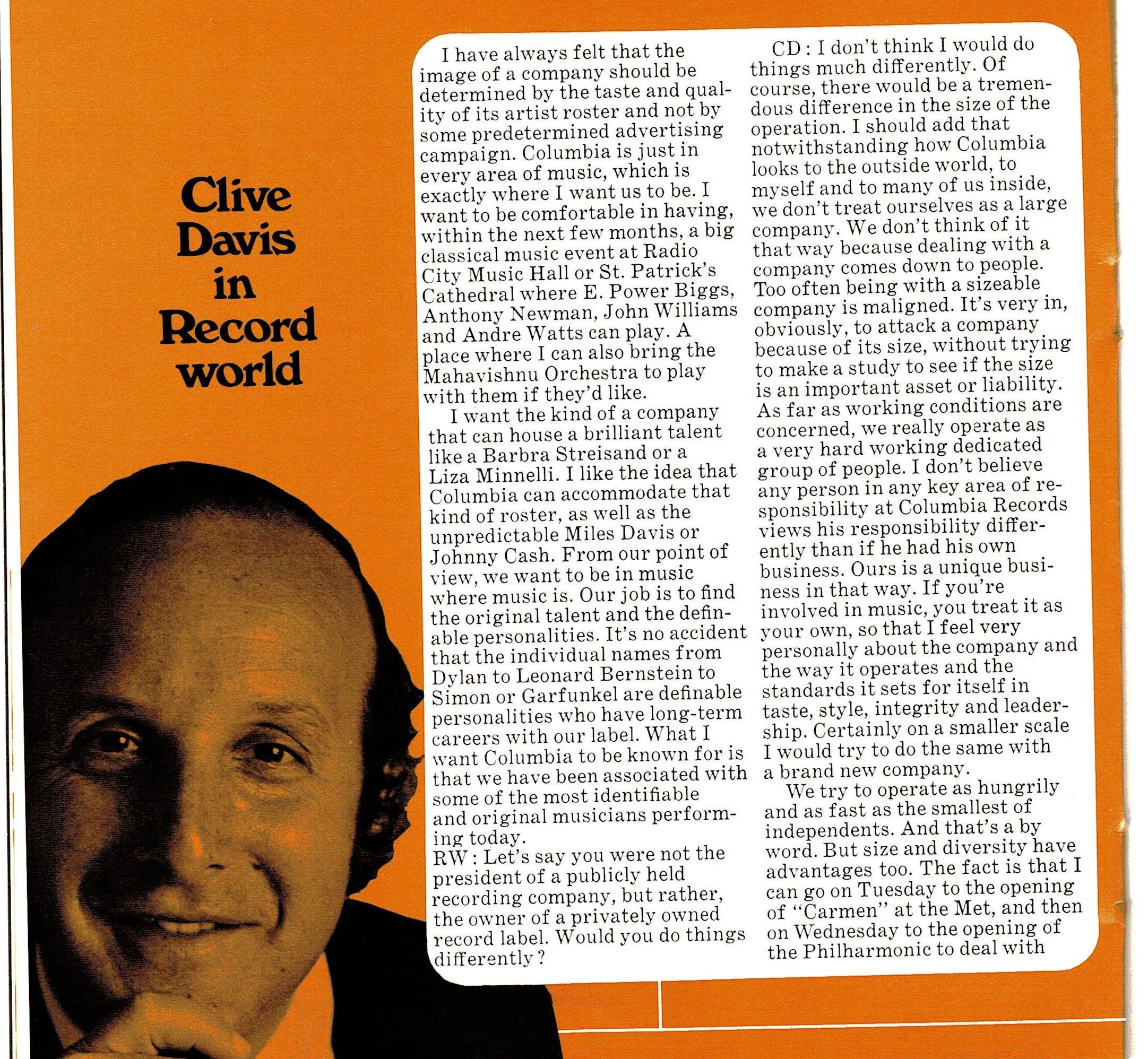
We had just returned from Los Angeles, where Clive had personally hosted “A Week to Remember,” a series of concerts featuring CBS artists, at the Ahmanson Theater of the Dorothy Chandler Pavillion. We had completed the special Ahmanson issue of Playback, on which every one of the 16 or 24 pages had a photo or two of Clive with one of the two dozen or so artists who appeared. And Clive, of course, was mentioned in every story. I had a sick day during which I was proofreading the galleys at home when Sarlin called me from the office, and with a straight urgent voice read me the press release from CBS Inc. he had just been handed: That Clive Davis was fired, effective immediately, for expense account inconsistencies and other trumped up charges. (He had written off his son’s bar-mitzvah at the Plaza Hotel as a business expense of more than $100,000; he had earned the company in recent years, I would guess, more than $100 million dollars.) The palace intrigue went all the way to the top of the company, since CBS newsman Dan Rather was hitting President Nixon hard during the ongoing Watergate scandal, and CBS chairman William Paley was said to be afraid of, or threatened by, punitive action by Nixon in the form of the FCC’s refusal to renew a certain number of broadcast licenses for CBS affiliates.
Our task, then, was to take the galleys of Playback and remove and replace every mention of Clive Davis, and replace them with...something that was not a gaping hole. My comment to Sarlin was: This is what it must be like working for Pravda.
Davis bounced back, writing an autobiography, starting Arista Records, after New York City’s high school honor society, with the financial backing from Columbia Pictures.
The Arista roster was an intentional blend of bland middle of the road artists such as Barry Manilow, Air Supply, and the smooth jazz sax player Kenny G., and more adventurous signings like the Patti Smith Group, Lou Reed at his most truculent. I was friendly with Clive’s first Arista hire, A&R executive Rick Chertoff, and the three of us planned dinner together in Manhattan. But first we visited Reed in the studio; Clive wanted to check progress on his new album. Reed was swigging Dewear’s Scotch from a bottle, and had nothing pleasant to say to Clive at all. Clive didn’t flinch. Eventually, we made it to Frankie and Johnny’s steakhouse, where Clive ordered a steak and linguini with clam sauce. It was close to 11 pm.
Arista also Graham Parker, and southern rock band The Outlaws. Eurythmics were great. The Alan Parsons Project were more prog than rock. And Arista did not miss out on the MTV new wave bands such as Haircut 100 and A Flock of Seagulls. Carly Simon, Hall & Oates, R&B stars such as Jeffrey Osborne kept the roster deep, though Clive intentionally avoided country music and classical, anchors of CBS during his years. .Luther Vandross had a hit with Arista’s Dionne Warwick, and he later signed with Davis’ post-Arista J Records.
The two rock legends Clive was proud to have revived as commercial entities were The Kinks, and the Grateful Dead. The Kinks made around 10 good and commercial albums for Arista in the late 1970s and early 1980s, including the top 10 hit “Come Dancing.” The Grateful Dead were more controversial, since these perennial sales underachievers, were thought not suited for the studio, especially when Davis paired them with Keith Olsen, who had just produced Fleetwood Mac. From “Rumours” to “Terrapin Station”: That was a trip. Deadheads still object, but as usual, it worked, and the Dead stayed with Arista for a dozen years, through “Shakedown Street,” “Go to Heaven,” and eventually, the hit single “Touch of Grey.”
Clive put extra work into his r&b artists, signing Aretha Franklin, returning her to the charts in the 1980s with “Who’s Zoomin’ Who?” a platinum album in 1985. I recall one awkward moment at a press party for Aretha after a show at Radio City Music Hall. It was held at the Top of the Sixes, I believe, or one of those other nearby penthouse restaurants. The problem was that Aretha did not fly, and her phobias also included heights. The place was packed, but Franklin didn’t like elevators much. I remember Clive fretting, trying to figure out how to get Aretha into an elevator. Eventually, she arrived, but I was never sure how.
Whitney Houston was Clive’s jewel. I remember him locking the doors at a posh press event introducing perhaps her Arista debut, so that no one could leave, or get a drink, until the playing of the album was over. He helped choose material, and some thought, took too much or merely just enough credit for her success. She died at the Beverly Hilton Hotel the night of one of Clive’s famed pre-Grammy parties. The party went on.
On this Toronto trip, I asked Clive about his work habits, so to speak: That like the few record executives who reach his level, the music business was more than “a way of life,” but life itself. His reply:
“I have friends I care about, charities, issues, I consider myself politically aware, so if one is trying to draw a picture, of me with blinders on, that’s all I think about, that would be misleading. On the other hand, it’s not a chore to work, I love it. It’s not a chore, that when I get home, if Dylan has a new album, or Springsteen has a new album, or if there’s a new artist coming along, yes, l’m eager, because I love the music. . . I find I love what I’m doing, and I find the fulfillment that comes is not just running a company or finding executives or signing artists. It is finding songs for those who need it, and knowing when to back away. Because it’s the artists career, its a lesson one should learn early. When you find the Patti Smiths of the world, self-contained artists with something to say, it’s wonderfully exciting.”
Really wonderful memories, Wayne, written with such fondness. I met Clive once, remind to tell you the story sometime.
He was an adventure for sure. What an ear, what a rive, what a life! Thank you, Clive!